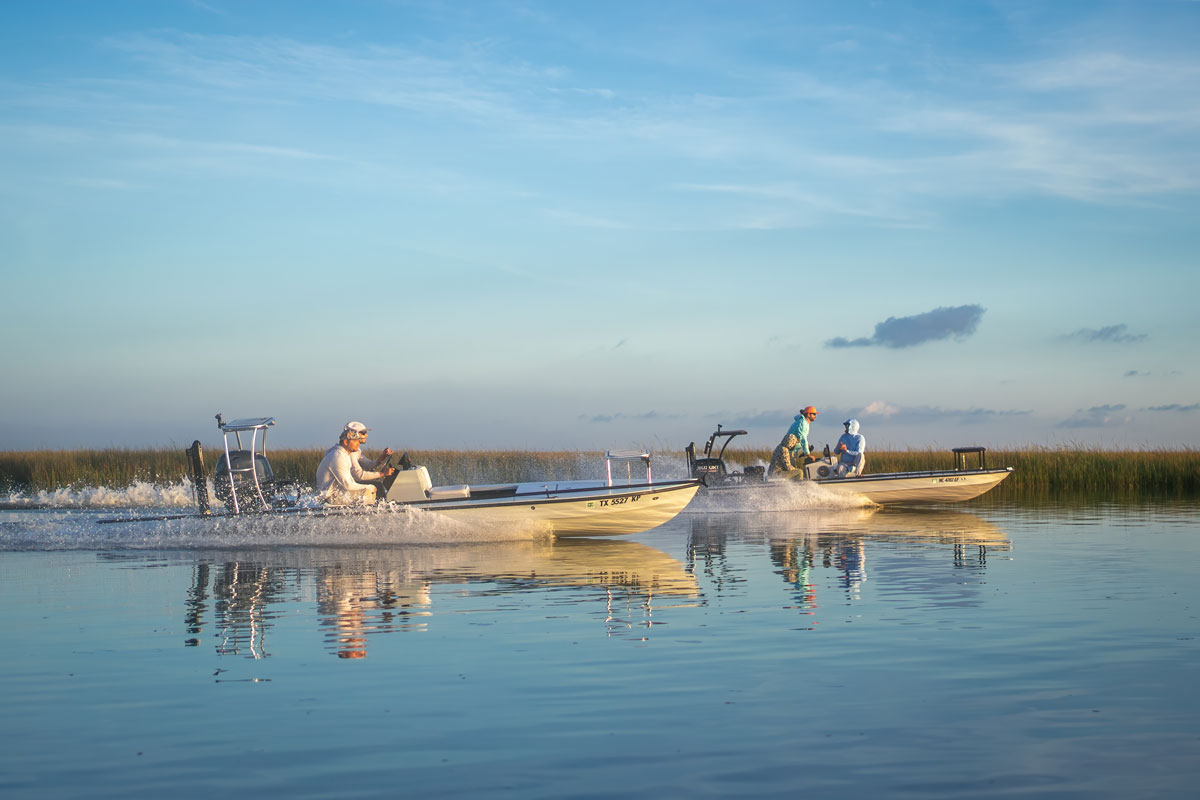
It’s a recipe for road trip magic: Little Debbie Swiss Rolls, Dr. Dre, crawfish ètoufèe, 30 miles-per-hour winds, and Louisiana redfish the size of a small cow.
Words and photographs by Captain John Mauser
If I can fall asleep now, I think to myself, I’ll get two solid hours of shut-eye. That should be enough for a drive halfway across the continent.
It’s already 9 p.m. and the guys will be here soon. Eventually, I doze off, only to be awakened—instantly, it seems—by the alarm. I checked my phone. There’s a text waiting: “Headed your way, be there in twenty.” I jump out of bed immediately for fear of falling back asleep.
When I open the front door, the crisp air of early December hits me in the face. I don’t have time to waste, so I start hauling gear to the end of the driveway. The headlights of the convoy stab the night. Three trucks, with two skiffs in tow, pull into my cul-de-sac. Justin backs up to my skiff and trailer in the front yard. I’m the final piece of the puzzle. It’s time to hit the road.
Eric crawls into the back seat, and I hop into the passenger seat as Justin loads the address to our rental in South Louisiana into his GPS. It’s a haul: 14 hours, not counting stops.
“Ready for this?” asks Justin, with a smirk on his face.
“Ready as I’ll ever be,” I grin back, as I wonder to myself how ironic it is that someone who guides anglers for redfish for a living caps off the year by traveling a thousand miles to another state to chase redfish for one more week. Most of this gang makes the choice. Half of us are fishing guides, with a great redfish fishery in our own backyards, and one that we can successfully fish year-round. But here we are. Six guys trailering skiffs across six states to chase a fish that lives a five-minute drive from my house.
This is our tenth trip to Louisiana. What started as an idea between my friend Perry and me turned into an annual event. Over the years, Perry and I have been joined by a rotating cast of characters—Dallas, Justin, Eric, Simmonds, and Brummet as the core group, along with several other friends. You could call it a tradition, a pilgrimage, or a guy’s trip. Whatever it is, it is something we look forward to all year long.
And this week is sacred. If we’re lucky, this crew fishes a half dozen times together in North Carolina each year. Back home, there is always one obligation or another pulling at us, and keeping us from sharing that quality time. During this one week in Louisiana each year, we pile into the same house to share dinner tables, front porches, and sunsets from the bows of our own skiffs, and we finally get to enjoy each other’s company beyond scattered calls on our marine radios. Once we pull away from the boat ramp, cell phone service vanishes. You couldn’t find us if you wanted to. Finally, it’s just a bunch of friends, the marsh, and the source of our passion.
Redfish.

In the kitchen of our rental hangs a huge, laminated satellite image of the Louisiana marsh. On the afternoon of our arrival, we gather around the war room map and discuss the plan for the next day. Perry will head south with his skiff, while I head east. Brummet will check out the marsh to the north. Each night, while we take turns with dinner duty, the crew gathers around the map again, discussing the day and making plans for the next. There are no secrets among us. If we find something, we share it. The goal is for everyone to succeed this week.
Morning comes early. We pack breakfast, lunch, and boat snacks, with one can’t-do-without-it twist. Little Debbie Swiss Rolls have become the most sacred of our traditions. These morsels are frozen the night before and loaded into our coolers, and can only be eaten when an angler accomplishes something notable, like a personal best fish or a new species on fly.
Racing downstairs in my bibs and jacket, I can see the glow of twilight over the marsh to the east. We’ll be at the ramp in less than ten minutes, but the sun will already be above the horizon by then. Once we reach the launch, I run in to pay the ramp fee while the guys jockey for position between trout anglers and redfish guides. By the time I return, the boys have my skiff at the dock, and I hop in. Idling through the no-wake zone, I hear Perry crank up Rage Against the Machine’s “Bulls on Parade” through his speakers.
Come wit’ it now! Come wit’ it now!
By the time the last notes of the song fade, we are crossing the end of the no-wake zone, and it’s throttle down.
Racing into the glow of sunrise, all the stress of planning, packing, and running endless errands melts away. I take it all in: We are finally here. I’ve been dreaming about this moment for months, and as I look around the other skiffs running alongside mine, I can see it in everyone’s faces. They all feel, too: The promise of a new day on the water, with little pressure to perform, just the potential for memories to be made.

When we reach the first spot, I grab the push pole and scramble up the platform. I may be off the clock, but I have a hard time shaking the notion that I am a guide, and the poling platform is my wheelhouse.
Eric is first up on my bow, with an 8-weight rod and a fly we call the “Dre-touffèe.”
“The old standard?” I ask.
“When has it ever failed us?” he answers. We dreamt up the pattern and named it in honor of the rapper Dr. Dre. It sports a black Zonker strip with gold bead-chain. In less than five minutes, we have our first shot.
“Eric. Twelve o’clock. Fifty feet,” I say, in that clipped, direct tone of voice guides tend to use when the fish is closing in and there’s no time for anything but the facts. “His back just came out.”
The fish leisurely swims towards us, leaving swirls along the surface, and occasionally breaking the still water with its tail. Eric makes two false casts and lets loose, unrolling the line and leader. The fly lands just to the right of the fish. A few strips and the fly crosses the red’s path, quartering away from the fish like fleeing prey. The red instantly notices the black-and-gold fly and charges forward to inhale it. The quietness of the marsh erupts with shouts of excitement from the boat as we celebrate the hookup. Justin and I are every bit as excited as Eric. A few minutes later, I document Eric’s catch with a photograph before it’s released back into the water. Not a bull by any means, but a respectable 10-pound fish, and most importantly, one that was hungry.
Refusing to rotate, I climb back onto the platform to find a fish for Justin. Over the course of the day, we all have shots at fish. Eric capitalizes on most of his shots, while Justin hooks a few of his own. I manage to blow most of my opportunities, which can be hard to swallow as a guide. When you spend most of your time on the back of a skiff, you are quickly reminded that there is a difference between knowing where to put a fly and actually putting it there. No jumbos are caught on day one, but that doesn’t faze us. There were no phone calls, no bills, and no work. Just 10 hours on a skiff with three friends who are pumped to hang out and cheer each other on. As the sun disappears below the horizon, we race back to the dock, looking forward to dinner and a meeting by the map. There are reports to discuss, stories to tell, and plans to make.

Mild weather greets the gang the next morning. Low winds and sunshine allow us to focus on the areas of clear water we located the day before. The boys insist that I take the bow first, and I begrudgingly agree. Our first stop provides me with shots at three big redfish. The first two fish are moving away, and I don’t stand much of a chance, while the third just plain refuses the fly. Later, Justin sticks two nice fish, and Eric lands a stud 43-inch bruiser. That night, over a spaghetti dinner, everyone has a chance to replay the wins and losses and retell all the inappropriate jokes. I’ve had a second fishless day, but I’m still in good spirits. At least, so far. We finish the night by circling around the war room chart and digesting the forecast of 20 miles per hour sustained winds the following day, with gusts in the upper 30s. We agree to sleep in the next morning and make a last-minute plan over breakfast.
Sometime in the middle of the night, I roll over and awaken with a start. The house seems to be shaking on its stilts. I listen to the wind roaring past my window like a haunted freight train. When I walk into the kitchen around 8 a.m., Perry and Simmonds are already making coffee and fixing an annual delicacy: Breakfast PB&Js.
“Doesn’t look too good,” grouses Perry. As Dallas and Brummet join us for breakfast, we discuss the next best thing to do on a blow day besides fishing: Where we’re going to eat lunch. During our first few years of traveling to Louisiana, we typically headed to New Orleans, drawn by the big city’s reputation. Over the years, though, we’ve homed in on local roadside diners and dives for crawfish etouffee and alligator bites. Breakfast has hardly hit the bottom of our stomachs when we pile into one of our favorite Cajun haunts and eat until we are stuffed. Crawling back in the trucks, we ride home, tie flies, and watch a Saturday Night Live marathon for the rest of the afternoon. Even hardcore fishing guides sometimes take the easy route.
I wake up early on day four, but my hopes are quickly dashed when I hear the winds still ripping outside. I’m not sure if I can stand another day off the water, so I ask the crew if anyone is up for extreme fly fishing. We’re all in, and make the call to take a late start and stick close to home, hopefully finding some relief from the breeze. After a midmorning launch, the three skiffs run the back canals towards a series of marsh ponds. Before we even reach our first location, I can see how low the water level is due to the wind blowing all night. Coming off plane, I make a dash for the platform and heave the skiff across the entrance to a shallow pond, scraping bottom while nearly losing the push pole in the mud. This battle against the marsh sets the scene for the entire day. We attempt several ponds before finding one that holds enough water for a redfish to swim in. Most of our day is spent trying not to get permanently stuck.
None of this matters. The lack of water, the lack of clarity, or the lack of reds. It’s days like this that remind you how little of the equation actually involves fish. I put so much pressure on myself as a guide back home that I often lose sight of why my clients are out there in the first place: To have a good time. We ride back through the canals as the sun sets on the horizon before us, excited about the weather forecast for our final day. That evening after tacos, we gather one final time around the satellite map to plan our next moves.

Running the canals alongside my friends that last morning is bittersweet. This trip has flown by, and I’m torn between wanting to get home to my family and wishing I could stay another week. Racing past ospreys, egrets, and a family of wild pigs, we make our way to the Gulf. A group decision has been made to stick close to each other today, and fish the same chain of large marsh islands together. Being the only fishless angler on the trip, I am again forced against my will to the bow of the skiff. For the next two hours, Eric guides me across gorgeous flats full of stingrays and blue crabs. One copse of mangroves is covered with dozens of roseate spoonbills. Redfish or not, this place really is paradise. I cast to a few sheepshead that have no interest in feathers or fur. About ready to step off the bow, I see a group of slot reds coming from my 1 o’clock. I make a quick back cast, give the line a few ticks, and all heck breaks loose as the lead fish crushes the fly.
I thought I had convinced myself that I was okay not catching a single fish during our trip, but the lack of hookups had been gnawing at me. Now I land a trip maker, and as I watch the redfish swim free from my hands, a sense of relief flows through me. Although the fish was no bigger than the ones we catch back home, it helped me kill the skunk for the week, and for that I am grateful.
Now Justin climbs up the poling platform and Eric reaches for his 10-weight loaded with a big blue and orange fly he has been dying to try. Poling into a large bay, Justin works parallel to the shoreline in three feet of clearing water. After a few minutes, the surface begins to tremble ahead of us, and soon we see the unmistakable wakes of several big redfish submarining below the surface. Eric goes into hunt mode as he scans the water for a shot. Something catches my eye.
“Eric,” I say, “11 o’clock. Do you see that colored spot?”
 As he swivels his head, a monstrous bull redfish floats up just below the surface. No one speaks a word as Eric makes a single false cast and sends the fly right to the red. A couple of strips and the fish keys in on the fly, following it halfway to the boat before opening its massive mouth and inhaling it. I can feel my stomach in my throat for a second as I watch this event unfold. Eric strip sets the red and that’s all it takes: Within seconds, the fish has the line flying off the reel, and then the backing follows. I instinctively go for my camera as Eric goes to battle. A few minutes later, he lands his personal best redfish ever. It’s pushing the mythical 50-inch mark, eclipsing his earlier stud red. We take a few moments to admire an absolute beast of a redfish. Even though we see and catch and guide to hundreds of redfish each year, coming face to face with such an old soldier is so special. Eric moves towards the edge of the skiff and slides the fish back into the water, holding on until it kicks free from his grip. As he stands up, wiping slime from his hands, Justin tosses him a frozen Little Debbie Swiss Roll from the cooler. “You earned it,” Justin says, with a nod of appreciation. “Now get off the bow. It’s my turn.”
 With a scattered school of fish still cruising around the bay, Justin takes the bow, and I get the skiff moving again. Within a few minutes, Justin hooks into his best fish of the week as the rest of the school makes a final exit from the bay. It is now early afternoon, and we are late for our lunch rendezvous with the other two skiffs. As we put towards the rest of the crew, Justin says, “John, it’s your turn, buddy, you’ve got the bow for the rest of the day.” Over lunch, each boat gives a rundown of the day and their plan for the afternoon. The reports from the other skiffs are positive, with a few bulls, two big black drum, and a sheepshead landed nearby.
After lunch, we idle down the shoreline to a massive bay that couldn’t look more perfect. Eric and Justin cheer me on as I take the bow for the rest of the day with mixed emotions. Deep down, I still want to hook a bull red, but I’m already feeling a rising tide of gratefulness. Big fish or not, the week has been incredible. When you turn the thing you love into your work and career, passion and burnout can battle. These trips to the Louisiana marsh remind me of why I picked up a fly rod in the first place. As the afternoon winds on and my luck dries up, I turn back to my pals in the skiff. “You know,” I say, “Louisiana has got to be the best place in the world to have a great time not catching fish.”
But it’s never been about the fish. It’s always been about carving out one week every year to be together, strengthen our bonds, and reconnect over something we all love. We tie too many flies, bring too much gear, and talk for months about big reds. But none of that is truly why we go. We go for the excitement, the camaraderie, and the soul healing that happens when a bunch of good friends share a skiff a thousand miles from home.