Who’s Next
Tomorrow’s legends are on the water today.
We Know Better For Captain Brandon Cyr of the Florida Keys, there’s no time like the present
By T. Edward Nickens
 There was this one kid, Captain Brandon Cyr recalls, who came to fish with him every year. He was consumed with saltwater fly fishing. He was in college somewhere in New York and would text Cyr photos of his fly casting in Central Park, with ice in the rod guides. He sent a lot of photos of the flies he tied, and pumped Cyr for advice and guidance. The flies were always stuck on some random piece of cardboard. “I thought it was a little weird,” Cyr says, “but whatever. Maybe he didn’t want to get his flies dirty.”
Once, when the kid was on a buddy trip to the Keys, Cyr had a chance to pull his friend aside. The young angler had recently sent him more photos of flies, on more pieces of cardboard, and there were cardboard boxes stacked up in the picture. Cyr was curious. There had to be more to the story.
“His buddy told me that his friend saves his money and eats nothing but ramen and beans so that he can afford to come down here and fish with me,” Cyr says, shaking his head in near disbelief. “He orders the ramen and beans in bulk from Amazon, and the boxes are basically his furniture. When a new batch comes in, he throws the old boxes away and replaces them with the new boxes.”
The fellow went through a lot of cardboard.
Cyr was flabbergasted. “I mean, holy shit,” he says. “That’s dedication. I had a hard time charging him full price after that, so he got a pretty significant discount. But now the kid is crushing life and making tons of money, so he might be back to full price one day. But that was really humbling, that someone would go to that kind of effort to fish with me.”
Humbling, but also inspiring. And perhaps a little familiar: That kid was just as crazy, just as committed, just as obsessed with saltwater fly fishing as Cyr is himself. What his client lacked in access, he made up for in ingenuity. Where he came short with funds, he made up for it with pure passion. Catching a fish on a fly wasn’t just a pastime for that kid in Central Park, or merely a fun way to spend an afternoon. It was everything that mattered.
It’s a perspective Cyr is familiar with.
“My wife always gives me shit for going at everything full speed,” he says. “Ever since the day I met her, which was right before a Del Brown Permit Tournament, she has always been on me. Man, why are you driving around so fast? Why are you so intense? And I told her: I live life like every day is tournament day. Every day is a day to try to be better and always improve.”
If that means a dinner of Amazon ramen served on a cardboard box, Cyr gets it. Sometimes the pursuit of perfection is a road only the driver can see.
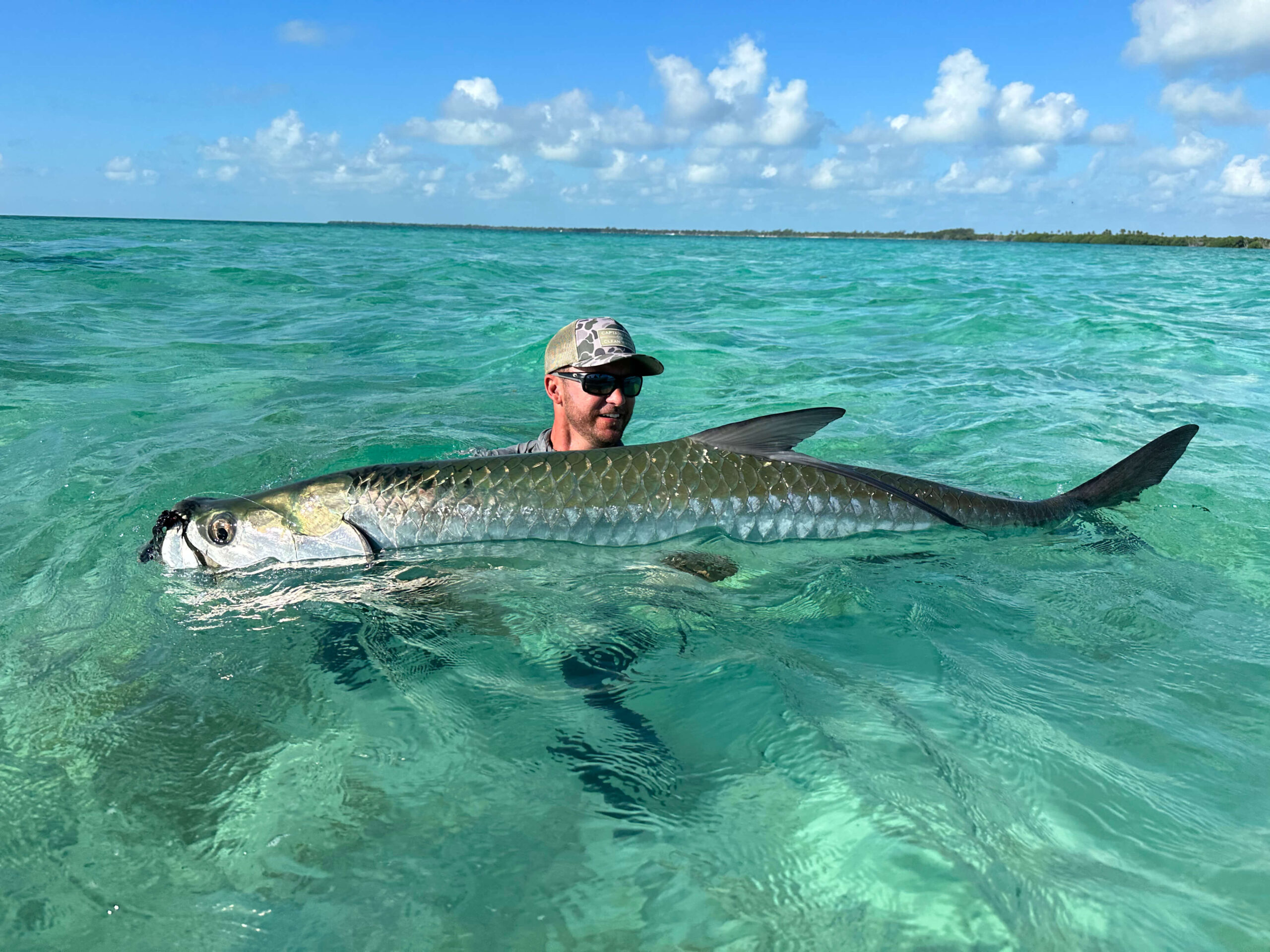
 Captain Brandon Cyr is a full-time fishing guide out of Big Pine Key, Florida, with an impressive slate of tournament wins, a reputation for poling the extra mile, and a zeal for conservation rooted in both a family heritage of Keys charter fishing and an enthusiasm for the future. He’s a seventh-generation Conch, with a heritage of street cred that reaches back to a man named Temple Pent, a schooner captain, turtle harvester, and one-time Biscayne Bay Lighthouse Keeper. Cyr grew up in a Key West fishing family. His father, Captain Mike Cyr, was a big-game bluewater charter captain for 30 years. The only time Cyr’s family didn’t live in the Keys was in the early 2000s, when the big-game charter business was struggling. When Brandon was in the second grade, the Cyrs moved to Hickory, North Carolina, where his dad took a job as the produce manager of a grocery store. Everyone was miserable. One day, the family was watching Jose Wejebe land sailfish off Key West during an episode of Spanish Fly. A wave of homesickness swept through the room. “My dad looked at us and asked, ‘Do you guys want to go home?’” Cyr recalls. “We all said, ‘Yep!’”
The North Carolina experiment lasted less than three months.
Cyr has never dreamed of living anywhere else. A week and a half after graduating from high school, he got his first boat loan. He bought a 17-foot Mitzi skiff, stripped down and basic. It didn’t even have trim tabs, he laughs. But it was a dream come true: at 18, he became a full-time guide.
Life came at him fast. During tarpon season, he would guide for 80 to 90 days straight. After washing the boat, he pulled a 5 p.m.-9 p.m. shift at Saltwater Angler in Key West, five nights a week. He felt his inexperience keenly. “I always loved to hunt bonefish and permit on my own,” he says. “But guiding was a different deal. All of a sudden, I had people who were paying me a lot of money to fish, and they’d pull up to this teenager who weighed maybe 145 pounds and couldn’t even grow a beard. I could see them thinking: What? I got set up with this kid?”
His daughter was born when he was 21, and the pressure intensified. He had other mouths to feed. He’ll admit that he played it safe. He could fish a harbor with live bait and put his clients on 15 tarpon, then catch some sharks, burn two gallons of gas a day, and call it done. He knew he was a better angler, but he was constantly worried. It was the easy route, and he had enough hard stuff in his life. “If I had 80 bucks to my name at the end of the month,” he says, “it was a good month.”
He had two things going for him. First, he had a work ethic forged in the charter fishing culture of the Florida Keys. His dad worked hard and worked hard every day. He’d lay it out straight: You don’t know when a hurricane could come through. You might not work for two months. You could lose your house, your vehicles, and your boat. You could lose everything in a 150 miles per hour instant. The only protection against that was an embrace of hard work.
And second, he had his big brother, Jared, who was four years older.
Growing up, the pair was inseparable, fishing, knocking around boats, doing all the Florida Keys things, until Jared hit his mid-teens and discovered girls and cars and interesting things that didn’t involve a fishing rod. Brandon didn’t handle that very well, he says. “I had a little resentment,” he admits. “To an eleven-year-old, all I knew was that I lost my fishing buddy.” There were a few tense years between the pair until Brandon himself discovered girls and cars and other interesting things, and suddenly his brother’s behavior made a lot more sense.

Captain Jared Cyr is another monster of a fly-fishing guide in the Keys, a decorated tournament guide, and another leader in the emerging nexus between fishing guides and fisheries science. He always pushed his younger brother to be better. When Cyr was sandbagging with the easy harbor tarpon, Jared knew his brother wasn’t being fair to himself. He called him out. “He would tell me: Go for it. It’s OK to fail. Push yourself,” Cyr says. Cyr began exploring different waters and techniques. He doubled down on his fly-casting clients. Jared was competing in tournaments; Brandon followed suit. Jared was dabbling in television shows. He showed Brandon the ropes.
“Jared really challenged me to challenge myself,” Cyr says. “I owe a lot of who I am and where I am today to my brother. No doubt about it.”
He relished learning on the job. While he’s widely known as Mike Ward’s tournament guide—Ward is the fly angler closing in on his 600th career permit—less attention is paid to the long road Cyr traveled as he learned the permit tournament game. He’d been in permit tournaments for nearly a decade before he fished Ward. He fished for three years with one angler who didn’t even know how to double haul. “I didn’t care,” Cyr says. “I was just excited to be in that world, and it was an honor to be around those people.”
It took the COVID pandemic to show him he needed to pump the breaks. The Keys shut down. Guiding shut down. He was newly married and home for three straight months. He’d met his wife, Amber, at the gym on her second day in the Keys. Their first date was a trip to shoot B-roll for a television show. “Her first day on the water down here, and she got to watch this National Geographic-level event of huge schools of mojarra and pilchards, with hundred-pound tarpon crashing through them. She was hooked, and we’ve been inseparable ever since. “There’s no way I could do what I do with Amber’s support,” Cyr says. “Every step of the way, she is right there with me.” In addition to eleven-year-old daughter, Erinn, they have a five-year-old son, Noah. “They are eighth-generation Conchs,” he says, “which is pretty cool. This place is absolutely, one-hundred-percent embedded in my DNA and my kids’ DNA.”
During the pandemic lockdown, he almost went bankrupt, he says, “but I had never been happier in my life. The quality time with my wife and daughter opened my eyes. And I saw what an amazing, intelligent, kind daughter I had, and I was so lucky for that because I missed so much of her younger years.”
He sat down with Amber, and they made a family pact: He would no longer work weekends. For a fishing guide, it’s a monumental shift. But the decision has made him, he insists, a better father and husband, and a better fishing guide. He’s not immune to the effects of a day-after-day grind. Many guides burn out. Others get short-tempered.
“But I get two days a week to do the one thing that makes me happier than fishing,” he says, “and that’s being with my family. My soul is revitalized after this two-day refresh with my wife and kids. Now I don’t get burned out. And I’m a natural-born hunter. So, by Sunday at five o’clock, dude, I am itching to get back onto the water.”
 It doesn’t take a genius to note that Brandon Cyr has a little Rob Fordyce in him. He is built like a three-log dock piling. Three days a week—after guiding, after dinner, after helping Amber put the kids to sleep—he drives 45 minutes each way to the same Key West gym where his dad would let him tag along as a four-year-old. His workouts clock in at two hours, for a nearly four-hour commitment to heavy metal.
He is a fitness devotee, meticulous and methodical. He eats six small meals a day and weighs all of his food to the gram. Percentages of carbohydrates, fats, and protein are strategically plotted: Meal #1 is an apple, 150 grams of cooked white rice, 170 grams of chicken or fish, and 60 grams of vegetables. Meal #2 is not much more. His clients are accustomed to him pulling out a tub of grub at precisely 10 a.m. He doesn’t share their subs and fried chicken.
They’re also accustomed to him poling into the wind with endless ferocity and approaching the last flat of the day with the same fervor and intensity as he approached the first. Which is the point. “I enjoy food,” he insists. “But eating to me is more of a mathematical equation to fuel my mind and body as best I can, to keep me performing at my best. That came from my dad: That was a part of his life: Taking care of your body so you could be a better everything—father, husband, and guide.”
That meticulous bent of mind is also evident in Cyr’s deep involvement in flats fisheries science. His work with Bonefish & Tarpon Trust (BTT), Lower Keys Guides Association (LKGA), and American Saltwater Guides Association (ASGA) exemplifies a growing confluence between fishing guides, scientists, and conservation advocates. For years, he clipped fin samples and collected tarpon scales as part of DNA sampling for flats fishery studies. In 2018, he teamed up with BTT, in partnership with Florida International University and Sweden’s Umeå University, for a more immersive study. Cyr caught and landed bonefish while Dr. Ross Boucek of BTT took blood samples boatside. That work culminated in a landmark finding: Of 93 fish sampled in South Florida, an average of seven different pharmaceutical drugs were evident in the fish’s tissues. One fish showed traces of seventeen medications.
In the years since, Cyr has helped with projects that have tagged bonefish, permit, and jack crevalle with both static and acoustic tags. In southwestern Baja in 2022, as part of a team with Costa del Mar’s Marlin Fly Project, he landed the first fly-caught Pacific striped marlin to be outfitted with a satellite tag. Working from a small wooden panga, Cyr and Captain Cody Rubner and scientists from The Billfish Foundation, International Game Fish Association, and the University of Southern Mississippi Center for Fisheries Research & Development deployed 15 satellite tags in only two days of fishing from a wooden panga. It was the first known billfish research campaign using exclusively fly-fishing tackle. And he is increasingly involved in advocacy, speaking up for flats fisheries resources. “I give credit to Benny Blanco for that,” Cyr says. “He has been such a mentor, and he was the one that was encouraging me: ‘Your voice matters. If you don’t think you’re being heard, then speak louder.’”
Cyr rarely says “no” to a project that pushes the scientific basis for conservation. He was one of the guides whose local knowledge of bonefish aggregations led scientists to discover the first known spawning grounds of bonefish in the Florida Keys. In late 2023, when high numbers of fish spinning in circles were reported in the Everglades, Cyr was on the water nearly every night, he says, collecting water samples for testing. Eventually, a toxic algae was fingered as the likely culprit causing the “spinning fish” outbreak that killed more than fifty endangered smalltooth sawfish.
That work is an evolution of attitude for a guide brought up in the offshore fishing industry. Cyr is just old enough to remember the nail boards filled with dead fish at dockside, a charter captain’s primary means of advertising. It was a mentality, he says, rooted in the fact that charter captains booked more often based on how many fish they brought home.
“They didn’t know better,” he says. “But today, we do.” There are still differing opinions in the charter fishing world that bring on “difficult conversations,” Cyr says, and he doesn’t have all the answers. “You’re not going to change everybody’s mind,” he says. “You’re not going to win over everyone. But at the end of the day, I’m going to go with the data and the facts and hope that people use their intellect to recognize what’s right and wrong. The one thing I can say is that I sleep better at night knowing that I tried to make a difference.”
Saltwater fly fishing, Cyr figures, is in an interesting place. The past and the future seem increasingly compressed. “What other sport can you think of where the founders are still alive?” he asks. “Fly fishing as a whole is so young and so small and so new, and especially saltwater fly fishing, that it’s incredible we have the opportunity to speak to the true pioneers still. We’ve lost Lefty Kreh and Stu Apte and Flip Pallot, but only recently. And look at all the amazing people we still have around us.”
Meanwhile, he’d been watching the average age of his clientele get younger. He figures most of his anglers are between 27 and 45—a definite change. He’s 33 years old—a kid himself, some would say.
He’s also watched as older clients have shown an increasing interest in funding and conservation, matched by younger clients ready and willing to throw themselves into policy action and boots-on-the-ground science. “It’s such a cool thing to see them come together,” he says. “Right now, we have a truly beautiful dynamic going on in the fly-fishing industry.”
The challenge will be to match this moment with a clear-eyed vision of what is possible. At a gathering of scientists not long ago, Cyr was in the audience listening to speaker after speaker lament the obstacles of the current era and the profound changes over the last few decades. Some were adamant: Today’s generations would never see what they had seen. The glory days were all behind.
“It just broke my heart to hear all these people talking about the past and how it could never be that good again,” Cyr says. “We know what’s in front of us, but it was a beat-down. And then—I will never forget this—Gordy Hill got up to speak.”
Dr. Gordon Hill is a retired orthopedic surgeon who arrived in the Keys in 1962 and embarked on a six-decade rewriting of what was possible with tarpon on a fly. And he had a message.
“I’m going to put this in my own words,” Cyr says, “But basically, this hero of mine called the crowd out. He said: Look at all the younger people in this room. They’re here to learn. They’re here to support science and rebuild these fisheries. We are literally surrounded by young people who want change. And I have more hope than I’ve ever had because these kids are here.”
Cyr was stunned. It was exactly how he felt. No one needed to tell the sons of Captain Mike Cyr what things used to be like. But Brandon Cyr had seen his generation show up for change. He’d witnessed the comeback of bonefish in the Florida Keys and Biscayne Bay. He wasn’t looking at the world through rose-colored glasses. But he wasn’t throwing in the towel, either.
“It was,” he says, “one of the most empowering speeches I’ve ever heard. Here was this man, a legend in my mind, who didn’t want to talk about himself but wanted to fuel the fire for the next generation. I thought that was incredible. We still have one of the best fisheries in the world. We have so many people willing to fight for them. It goes to show that hope is never lost as long as you’re willing to put in the effort.”
Which sounds something close to legendary.

Other Personalities and Features: