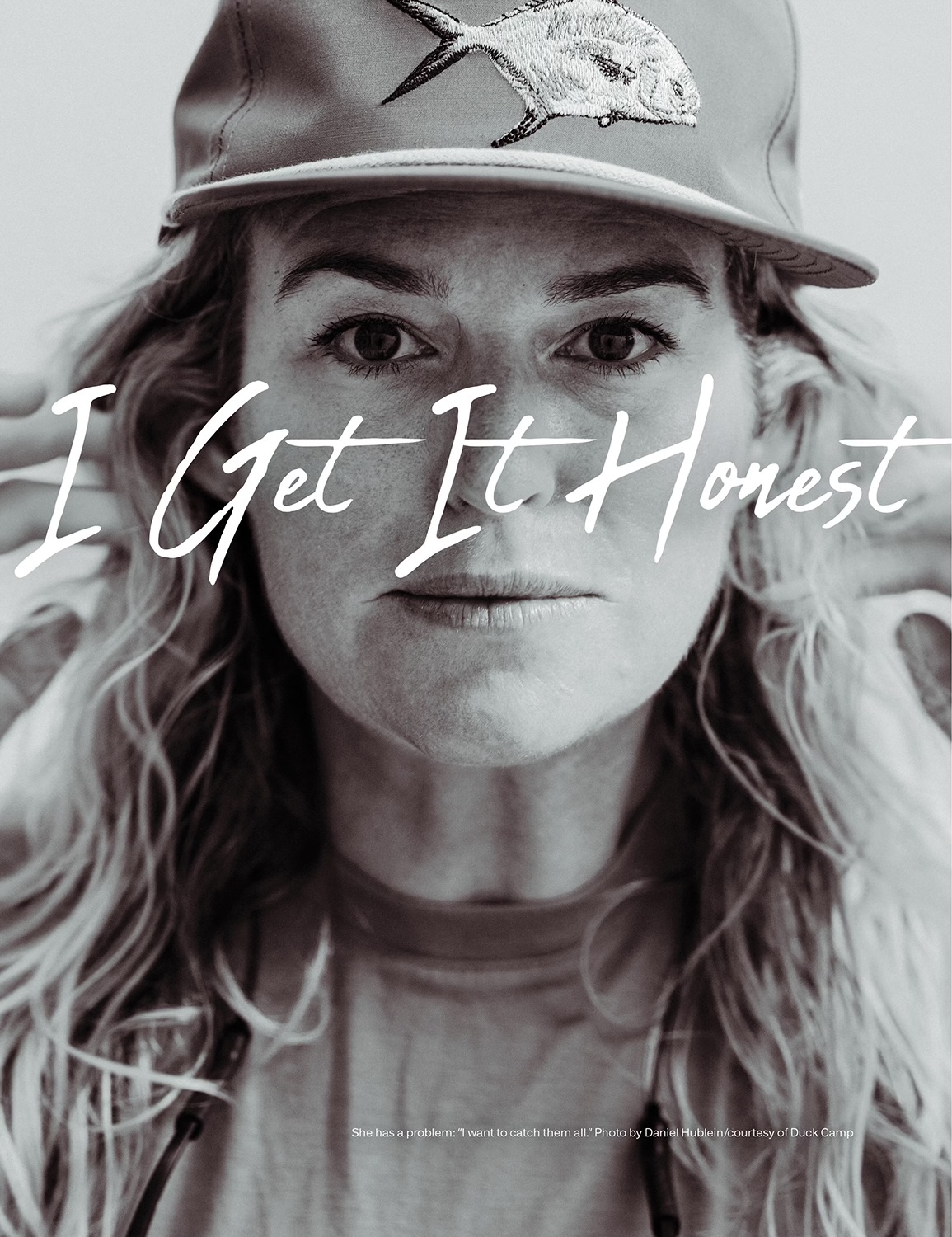
I Get It Honest
She talks a mile a minute and still can’t get it all out. But Captain Lacey Kelly has five generations of Old Florida blood running through her veins. We’d do well to listen.
By Captain Lacey Kelly
It’s funny. I’ve tried to get away from it during certain periods in my life. I’ve tried to work a few corporate jobs over the years, in between part-time guiding gigs. The theory of making a lot of money now so you can be on the bow later was definitely something that affected my path. It caused some turbulent tides. Trust me, I have certainly tried it the hard way. It’s safe to say I get it “honest.” From both sides of my family.
Guiding is my calling. I’ve fully immersed myself in a space that is regarded as sacred and admirable, which often seems to be overlooked these days. I know this sounds like it’s warming up to be another fishing story, but it’s not. It’s really a family story, and how my family gradually shaped me into the fly guide I am today. Both sides were equal partners in creating this specimen that has a severe addiction to fishing and saltwater: the Kellys and the Edwards.
ROOTS: THE KELLYS
The Kelly family arrived in Fort Myers, Florida, in 1917 by train. They were headed south for Cuba from Bishopville, South Carolina, for reasons I cannot say. They were farmers, hunters, and fishermen, living off the land and the water, and when they stopped in Fort Myers, the farming, hunting, and fishing were ample enough to call it home. When my dad talks about the old days and the stories start flowing, the central theme has always been that we fished and hunted to provide for the family. It was all about sustenance. My dad said that every time he hooked a tarpon, my grandfather, Poppa, would grab a filet knife and cut it off, saying, “Boy, we can’t eat that.”
Hurricanes, the Great Depression, and World War II didn’t rattle my family as much as the government taking our family land in Fort Myers via eminent domain. On top of our farm and cattle ranch rose the Southwest Regional Airport. That changed the trajectory of my life and the entire landscape of southwest Florida. I’ve often struggled with the fact that I wasn’t born back then and did not get to see Southwest Florida in its prime.
Over the years, I’ve often been poling a flat hunting for fish and wondering what my great-grandads got to enjoy. They couldn’t see what Southwest Florida would become. They lived before mosquito control. They would rub motor oil from head to toe just to be able to clean their catch because the no-see-ums would cover you so bad that you couldn’t wipe them out of your eyes. My dad recalls asking his dad why he didn’t purchase the south end of Fort Myers Beach, and Poppa told him. “Ain’t nobody going to want to live out there amongst all them mosquitos and no-see-ums.” He told my dad that we used to ride down there in his Model A and fry fish, and he couldn’t comprehend how you could make a living off that land. He was a farmer. What would you do with it? He never thought about people buying it from him just to enjoy the landscape’s beauty.
We talked a lot about the old days. Poppa and my great-grandad, PawPaw, were fishing the mouth of the Caloosahatchee River one day, and this was before the Sanibel Bridge was built. The water was slicked out, and they said suddenly, they looked up, and a giant rogue wave was coming at them. They scratched their heads for a bit until it got closer and they realized it was a tsunami of redfish. They didn’t have spinning reels back then—they didn’t show up until 1954—but they grabbed their casting rods and headed out. They stayed on the school for three days and caught them till their arms wore out. They never saw another boat.
PawPaw’s name was Sam Headley, and he was the first in my family to guide, which was long before captain licenses were a thing. He often took out Mr. Burdine of Burdine stores that were all across Florida. They would snook fish on the inside of Captiva Pass, using live mullet and grouper rods. They would anchor Burdine’s 50-foot boat, and the whiskey and fishing stories of old started to flow. PawPaw lived on Fort Myers Beach but also spent a good amount of time working on Lake Okeechobee when the mallards were so thick they would block the sunlight. He worked on a dredge boat to build the dike after the hurricane of 1928 that killed so many folks on Lake O. He also caught a small otter, which he made into a pet. He would tell his otter to go get him a fish, and within a few minutes, it would come back with a fish in its mouth that he’d let go for PawPaw to eat later on in the day.
I wish I could have known my PawPaw, my great-grandfather Sam Headley. There are so many parallels between us that cannot be denied. PawPaw was friends with Thomas Edison’s son, and Edison even put a light bulb in the tree house for them one night when they were playing. Both my great-grandfathers spent time with Edison, Harvey Firestone, and Henry Ford at the Edison estate. I can recall Poppa telling me a story of Grandad Kelly frying fish in a cast iron pan at the Edison estate, a pan we still have to this day. He told my dad about making coquina shell soup and eating raw turtle eggs from Fort Myers Beach. They would look out across the Caloosahatchee River and see so many tarpon you could have walked on their backs. So many tarpon in the water that they referred to a school as a “black o’ tarpon” in the water. That’s a lot of fish.
ROOTS: THE EDWARDS
My mom was born in Miami, back when they used to call it “MI-AM-AH.” Her family lived so close to the Orange Bowl stadium that she could hear the games and see the lights from her front door. It was different times.
After my grandfather returned from serving in World War II in the Philippines, Miami wasn’t the same. The crime and crowds forced him to make a move north. Grandpa Ed loved snook, and he loved to snook fish so much that he packed the entire family up, sold the house, and was headed to Englewood, where the family had vacationed in prior years, which he knew was a good place for snook fishing. On the way north, he stopped to fuel up at a gas station in Bonita Springs. While the attendant was pumping the gas and chit-chatting, he asked my grandpa where they were going. My grandpa said they were headed to settle in Englewood because the snook fishing was so good there. The gas station attendant chuckled. “Why would you go all the way to Englewood,” he asked, “when the snook fishing is the best here in Bonita?”
It was settled: They bought a house on Mango Street off Bonita Beach Road and opened Ed’s Bake Shop. My mom was six years old and spent her childhood snook fishing and swimming all up and down the Imperial River. And working at the bakery. It was the first bakery on Bonita Beach and included a small convenience store with odds and ends.
I never got to meet my Grandpa Ed as he passed away before I was born, but I know that my love of snook comes from him; there is no doubt in my mind. And just like him, I’ve tried to get away from places that become more and more crowded, not only in town but on the water. Since my family arrived in 1917, Fort Myer’s population has grown from 3,000 people to over 100,000. Bonita Springs has grown since the 1950s from less than 1,000 people to over 40,000. That puts things in perspective.
 WINGS
WINGS
I cut my teeth guiding as a bait guide. Probably chipped a few teeth over the years, too, with all those lead lines. Throwing a 10-foot cast net every morning and blacking out the live well was just as routine as brushing my teeth. I knew something was missing, though, and it took a few
years to find my ultimate passion. As far as I’ve been told, no one in my family on either side ever fly fished until my Aunt Karen married my Uncle Dennis.
Uncle Dennis and Aunt KK—that’s what everyone calls her—traveled out West for the summer months in their motorhome. For 15 years, they bounced from river to river and fly show to fly show, fishing with some of the greats like Kelly Gallup and Jack Dennis. Their stories went on forever. Some of my earliest childhood memories were of them returning and showing me pictures of all the trout they caught on fly. When I was 20, they flew me out to meet them in Yellowstone. It was my first trip to the West, and the first fish I caught on fly came out of the Gallatin River. Uncle Dennis and Aunt KK probably don’t know how much that one trip and that one fish impacted my life and the path I would take. Flyfishing is interwoven into
every part of my life now. It’s how I’ve met some of my best friends and the love of
my life. It’s how I’ve met so many different people from so many walks of life.
After starting my guiding career and spending a decade on the water here, I moved to Belize for three years and traveled all over the world in between. Yet I’ve come back to Florida—come back home.
At first, I moved north to try to find the same experience that my ancestors found
here in the old days. I was lucky enough to fall in love with Homossasa and spent almost a
decade guiding for tarpon and redfish in what felt like the last frontier of wild Florida. But similar to how the tarpon migrate back to this place year after year, the lure of Southwest Florida, and the hold my family history has on me, lured me back home. I’ve begun to recognize that my family heritage carries a responsibility to keep the family stories alive and protect the waters that helped create them. Their stories create a baseline for all of us to better understand the potential of what it could be if we take care of the resource. Without their stories, we can’t properly gauge how to protect our waters and wild places for future generations.
Maybe that’s why my mindset has shifted over the years. Flyfishing is everything to me now; it’s my center and my compass in life. It’s changed my perspective on so many aspects of fishing. One thing that has changed is that I am catch-and-release only inshore. I’ve come to this decision for several reasons.
It was a journey to get here, that’s for sure. I spent the majority of my early years guiding and filleting fish for clients. I was fully immersed in that culture of filling the cooler. A typical day in bait guiding usually started with the folks stepping on the boat and blurting out, “Captain, are we going to catch our limit today?” Upon my return to the dock, it gave me a sense of accomplishment that I could show the other guides that they weren’t the only ones who could catch fish. That was one of the ways I earned the respect I’m still shown by those same
guides more than 20 years later. At the time, I was the only full-time female fishing guide in
southwest Florida who made a living solely off guiding.
It was so important to me to be accepted by my peers on the water. I was an impressionable young guide, and like all the others, I did what the old guides did. I caught a limit of fish for clients, filleted them, packed them up, sent the anglers home, and did it all over again the next day and the day after. Being raised as a sustenance fisherman, I never gave it a second thought until I started guiding fly fishing. Suddenly, the fish took on a different kind of importance to me.
I think that’s because other things started being important to me. It’s hard to explain, but I know that the resource will go away if we don’t show it respect. That’s a fact. There are just so many of us around here now. What showing respect means to me might be different than what it means to you. But I’ve heard so many stories about how things used to be in this place I love that I can’t bring myself to treat my home any other way than with all the kindness I can find. I hope I can encourage other people to do the same.